
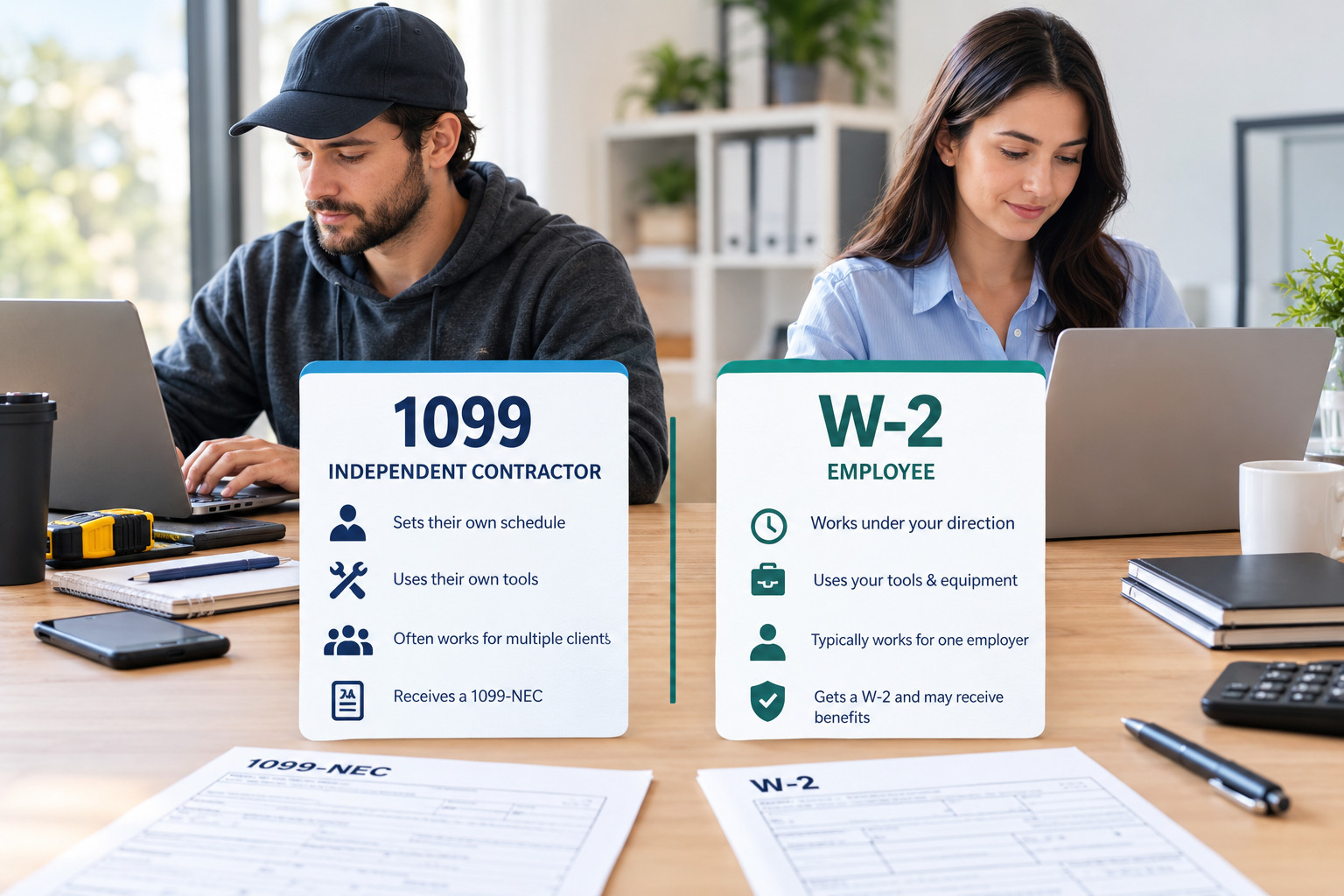
The difference between a 1099 worker and a W-2 employee comes down to control: if you control how, when, and where the work gets done, and provide the tools to do it, that person is legally a W-2 employee — not a 1099 independent contractor, regardless of what the agreement calls them. Misclassifying a W-2 employee as a 1099 contractor is one of the most common and costly mistakes small businesses make, with IRS penalties that can include back taxes, interest, and fines per misclassified worker.
As Q4 approaches and businesses start preparing 1099s and W-2s for the year, this is exactly the right time to double-check that every worker on your payroll is classified correctly — before, not after, forms go out. Here’s how to tell the difference and what’s at risk if it’s done wrong.
1099 vs W-2: The Core Difference
A W-2 employee works under your direction — you set their schedule, tell them how to do the job, and provide the tools and equipment needed. In exchange, you withhold payroll taxes, pay the employer share of FICA, and may offer benefits.
A 1099 independent contractor runs their own business. They set their own hours, use their own tools, often work for multiple clients, and are responsible for their own self-employment taxes. You pay them a gross amount with nothing withheld, and report that payment on a 1099-NEC if it totals $600 or more for the year.
The job title or what you call the relationship doesn’t determine classification — the actual working relationship does.
The IRS Common Law Test
The IRS evaluates worker classification using three categories of evidence, often called the “common law test”:
- Behavioral control — Does the business direct how, when, and where the work is done? Does it provide training or detailed instructions?
- Financial control — Does the worker have unreimbursed expenses? Can they work for other clients? Are they paid a flat fee per project (contractor-like) or a regular wage (employee-like)?
- Type of relationship — Is there a written contract? Are benefits provided? Is the work ongoing and central to the business, or project-based and peripheral?
No single factor decides classification on its own — the IRS looks at the full picture. The more control a business exercises over the details of how work gets done, the more likely that worker is legally an employee.
1099 vs W-2: Side-by-Side Comparison
| 1099 Contractor | W-2 Employee | |
|---|---|---|
| Who controls the work | Worker sets their own methods and schedule | Employer directs how and when work is done |
| Tools and equipment | Typically provided by the worker | Typically provided by the employer |
| Tax withholding | None — worker pays self-employment tax | Employer withholds income tax, FICA |
| Benefits | Not provided | May include health insurance, PTO, retirement |
| Works for multiple clients | Often, yes | Typically no |
| Year-end tax form | 1099-NEC | W-2 |
| Employer tax responsibility | None | FICA match, unemployment insurance |
Why Businesses Misclassify Workers
Misclassification often isn’t intentional fraud — it’s usually a business trying to save on payroll taxes and benefits costs, or simply not understanding where the legal line sits. Common scenarios that lead to misclassification include:
- Treating a long-term, ongoing worker as a contractor because it’s administratively simpler
- Paying someone a 1099 rate without realizing you control their schedule and methods
- Converting a former W-2 employee to 1099 status for the same role and duties
- Assuming a signed “independent contractor agreement” settles the classification on its own
A written contract calling someone a contractor does not override the actual working relationship in the eyes of the IRS.
Penalties for Worker Misclassification
If the IRS determines a worker was misclassified, penalties can include:
- Back payroll taxes — the employer share of FICA that should have been withheld and paid
- Failure-to-withhold penalties — a percentage of the wages that should have had income tax withheld
- Interest on unpaid amounts, accruing from when they were originally due
- Additional fines for intentional disregard of classification rules, which are significantly higher than penalties for good-faith mistakes
In some cases, businesses may qualify for reduced penalties under the IRS Voluntary Classification Settlement Program if they come forward and correct the issue before an audit begins.
How to Correctly Classify a Worker
Before classifying anyone as a 1099 contractor, ask:
- Do I control how, when, and where this work gets done? (If yes, leans W-2)
- Does this person use their own tools and equipment? (If yes, leans 1099)
- Do they work for other clients besides my business? (If yes, leans 1099)
- Is this an ongoing role central to my business, or a defined project? (Ongoing/central leans W-2)
- Am I providing training on how to do the work? (If yes, leans W-2)
If the answers point in different directions, it’s worth a closer review rather than defaulting to whichever classification is cheaper. Getting this right from the start avoids a much more expensive correction later. Once a worker is correctly classified, our guide on 1099 filing deadlines covers exactly when and how to file their year-end forms, and if the worker is actually a W-2 employee, our breakdown of payroll services for small business covers what’s involved in running payroll correctly.
What to Do If You’ve Misclassified Someone
If you suspect a current or past worker has been misclassified:
- Review the relationship against the IRS common law test factors above
- Consult with a tax professional before making changes, since corrections can affect prior filings
- Consider the IRS Voluntary Classification Settlement Program if reclassifying going forward
- Set up proper payroll withholding immediately for any worker now classified as a W-2 employee
- Keep documentation of the review process and reasoning for your records
Correcting a misclassification proactively is almost always less costly than having it discovered during an IRS audit.
Getting Worker Classification Right Before Year-End
As 1099s and W-2s get prepared for the year, this is the moment to confirm every worker is classified correctly — not after forms have already gone out. See our Business Tax Preparation and Payroll Management Services to see how we help Sanford-area businesses handle this correctly, or browse our full range of services.
For the IRS’s official classification guidance, see the IRS Independent Contractor vs. Employee page.
Frequently Asked Questions
What determines if a worker is 1099 or W-2? Classification depends on the level of control a business has over how, when, and where work is performed, financial control over the worker’s expenses and pay structure, and the nature of the ongoing relationship — not what the agreement calls the worker.
What happens if I misclassify an employee as a 1099 contractor? Misclassification can result in back payroll taxes, failure-to-withhold penalties, interest, and additional fines, particularly if the IRS determines the misclassification was intentional.
Can a worker be both a 1099 contractor and a W-2 employee for the same business? Generally, no, for the same role and duties. However, a person could be a W-2 employee for one role and separately provide genuinely distinct contracted services for the same business.
Does a signed independent contractor agreement protect me from misclassification penalties? No. The IRS evaluates the actual working relationship, not just the terms of a written agreement. A contract alone doesn’t override how much control the business actually exercises over the work.
What should I do if I think I’ve misclassified a worker? Review the relationship against IRS classification criteria, consult a tax professional, and consider voluntary correction programs before an audit identifies the issue, since proactive correction typically results in lower penalties.
Not Sure If Your Workers Are Classified Correctly?
Getting this wrong is an expensive mistake to catch late. Book a free consultation with our Sanford, FL team to review your worker classifications before year-end, or visit our homepage to learn more.