A profit and loss statement (also called a P&L or income statement) shows how much money your business earned and spent over a specific period, such as a month, quarter, or year. To read one, start at the top with revenue, subtract the direct costs of delivering your product or service to get gross profit, subtract your operating expenses to get operating income, and the final line, net profit, is what your business actually earned after all costs. If net profit is positive, you made money for that period. If it’s negative, you lost money.
That’s the short version. The longer version matters because a profit and loss statement is the report business owners, lenders, and tax preparers rely on most, yet many owners glance at the bottom line and never look further. This guide walks through each section, uses a realistic example from a Central Florida service business, and shows you what to look for so the numbers actually help you make decisions.
What Is a Profit and Loss Statement?
A profit and loss statement summarizes your revenue, costs, and expenses over a set period. It answers one question: did the business make or lose money during this time?
It is one of the three core financial statements. The other two are the balance sheet, which shows what you own and owe on a specific date, and the cash flow statement, which tracks actual cash movement. Each one tells a different part of the story.
| Statement | What It Shows | Time Frame |
|---|---|---|
| Profit and loss (P&L) | Revenue, expenses, and profit | A period (month, quarter, year) |
| Balance sheet | Assets, liabilities, and owner’s equity | A single date |
| Cash flow statement | Cash coming in and going out | A period |
What Are the Main Parts of a Profit and Loss Statement?
Every P&L follows the same basic order, from top to bottom:
- Revenue (sales or income): All money earned from selling products or services
- Cost of goods sold (COGS): The direct costs of producing what you sold, such as materials and direct labor
- Gross profit: Revenue minus COGS
- Operating expenses: The costs of running the business, such as rent, payroll, insurance, and marketing
- Operating income: Gross profit minus operating expenses
- Other income and expenses: Items outside normal operations, such as interest expense
- Net profit (net income): What’s left after everything is subtracted
The core formulas are:
- Gross profit = Revenue − Cost of goods sold
- Operating income = Gross profit − Operating expenses
- Net profit = Operating income − Other expenses + Other income
What Does a Real Profit and Loss Statement Look Like?
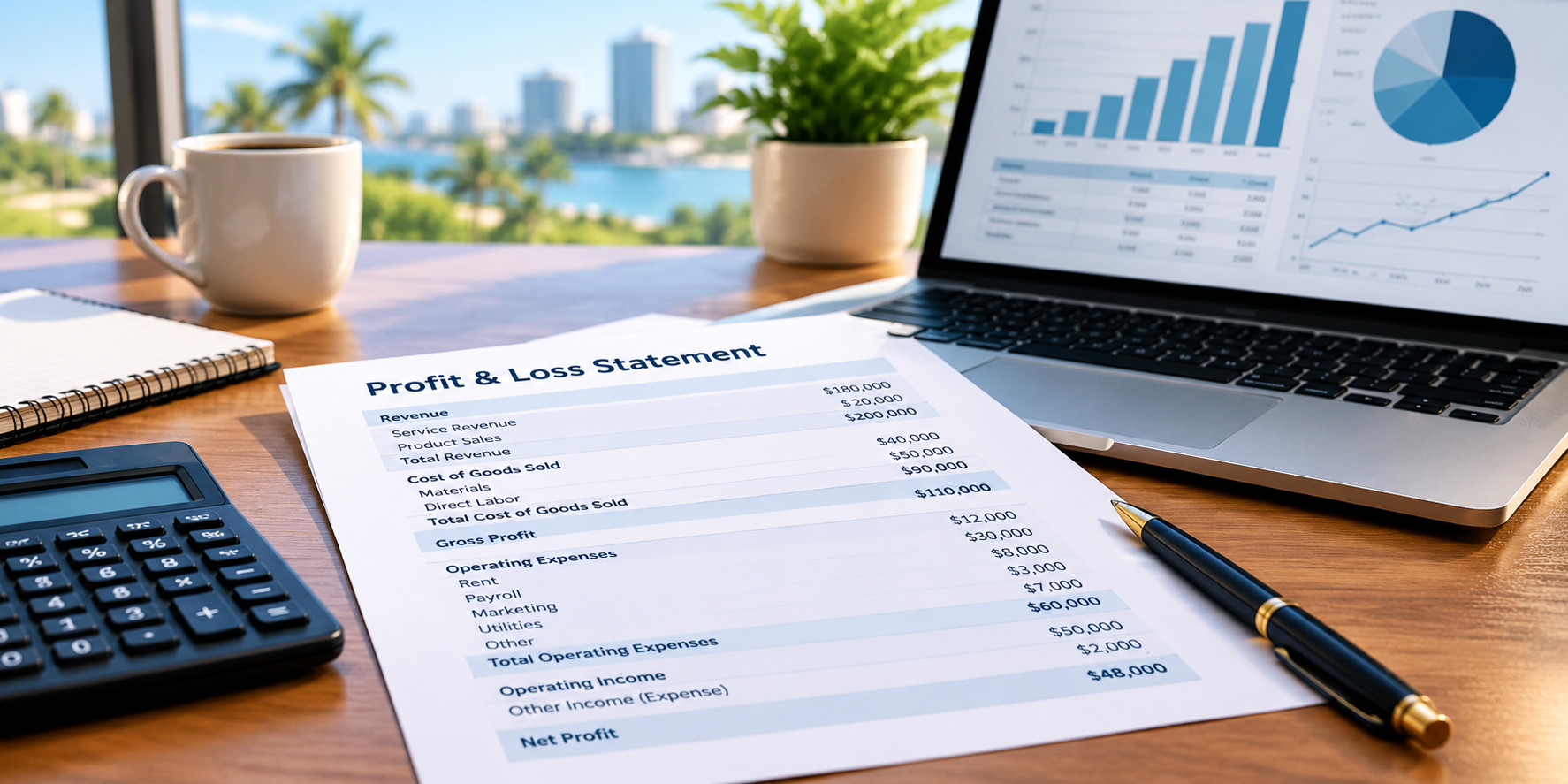
Here is a sample annual P&L for a fictional Sanford, Florida home-services company. The numbers are for illustration only.
| Line Item | Amount |
|---|---|
| Service revenue | $180,000 |
| Product and materials resale | $20,000 |
| Total revenue | $200,000 |
| Materials | $40,000 |
| Direct labor and subcontractors | $50,000 |
| Total cost of goods sold | $90,000 |
| Gross profit | $110,000 |
| Administrative payroll | $30,000 |
| Rent | $12,000 |
| Insurance | $6,000 |
| Marketing | $8,000 |
| Software and subscriptions | $4,000 |
| Vehicle and fuel | $7,000 |
| Professional fees | $5,000 |
| Utilities and phone | $3,000 |
| Other operating expenses | $5,000 |
| Total operating expenses | $80,000 |
| Operating income | $30,000 |
| Interest expense | $2,000 |
| Net profit before taxes | $28,000 |
How Do You Analyze a Profit and Loss Statement?
Reading the numbers is step one. Analyzing them is where the value is. Use these ratios, calculated from the example above:
- Gross profit margin = Gross profit ÷ Revenue. $110,000 ÷ $200,000 = 55%. This shows how much of each sales dollar remains after direct costs.
- Operating expense ratio = Operating expenses ÷ Revenue. $80,000 ÷ $200,000 = 40%. This shows how much overhead it takes to run the business.
- Net profit margin = Net profit ÷ Revenue. $28,000 ÷ $200,000 = 14%. This is the share of revenue you actually keep.
A single period only tells you so much. Compare the same statement across months, and compare this year to last year, to spot trends. A rising marketing line with flat revenue, or a shrinking gross margin, usually means something needs attention. Acceptable margins vary widely by industry, so compare yourself to similar businesses rather than a general benchmark.
What Should You Look for on Your Profit and Loss Statement?
When you open your own P&L, check these points:
- Is revenue growing, flat, or shrinking compared with the previous period?
- Is gross margin stable? A drop can mean rising material or labor costs, or pricing that hasn’t kept up.
- Which expenses are growing fastest? Small categories can quietly become large ones.
- Are there large “Uncategorized” or “Miscellaneous” balances? These hide information and often cost you deductions.
- Does net profit match what you expected? If not, the cause is usually categorization errors or timing.
What Are Common Profit and Loss Statement Mistakes?
Many P&Ls look wrong because of bookkeeping errors, not business performance. Watch for these:
- Owner draws recorded as expenses. For sole proprietors and LLC owners, draws are not business expenses, and they shouldn’t reduce profit.
- Loan principal payments recorded as expenses. Only the interest portion belongs on the P&L. The principal reduces a liability on the balance sheet.
- Estimated tax payments treated as deductible expenses. These are advance payments of your personal tax bill. Our guide to quarterly estimated taxes explains where they belong.
- Sales tax counted as revenue. Sales tax you collect belongs to the state and should be recorded as a liability, not income.
- Unreconciled bank accounts, which make every line less reliable.
- Inconsistent categories from month to month, which makes comparisons meaningless.
If your report looks off, our guide on how to categorize business expenses covers the standard categories most small businesses should use.
What Is the Difference Between Profit and Cash?
Net profit and cash in the bank are different numbers. A P&L records revenue when you earn it and expenses when you incur them, not necessarily when money moves. A business can show $28,000 in profit and still be short on cash because customers haven’t paid yet, inventory was purchased, or loan principal came due. This is why you should read your P&L alongside a cash flow report. We explain the gap in detail in our guide to small business cash flow management.
Cash vs. Accrual: Does It Change Your P&L?
Yes. Under cash-basis accounting, income and expenses are recorded when money actually changes hands. Under accrual-basis accounting, they’re recorded when earned or incurred. Many small businesses use cash basis for simplicity, while others need accrual for inventory or lender requirements. The method you choose affects when profit shows up, so make sure your P&L, your tax return, and your bookkeeper all use the same one.
Who Uses a Profit and Loss Statement, and Why Does It Matter?
A P&L is more than a monthly report. It’s used to:
- Prepare your tax return, since business income and deductions flow from it. Florida has no state personal income tax, but pass-through profit still reaches your federal return.
- Apply for loans or credit, since lenders typically request recent P&Ls
- Set pricing, by showing whether your margins can support your prices
- Control costs, by revealing which expenses are growing
- Plan year-end tax moves, including the deductions covered in our small business tax deductions guide
Reviewing it monthly, not just at tax time, is the habit that separates owners who feel in control from those who feel surprised. Our year-end bookkeeping checklist shows how to get your reports ready before December 31.
How Often Should You Review Your Profit and Loss Statement?
Review it monthly at minimum. Look at the current month, compare it to the prior month and the same month last year, and note anything unexpected. For Florida businesses with seasonal revenue, such as tourism-driven or snowbird-season companies, comparing against the same month last year is more useful than comparing against the previous month.
Can a Bookkeeper Help You Read and Improve Your P&L?
Yes. A P&L is only as accurate as the books behind it. A bookkeeper reconciles your accounts, categorizes transactions, and delivers clean monthly reports, and a financial analyst can then explain what the numbers mean and where to act. If your reports look wrong or you’re behind, QuickBooks clean up and catch up services can fix the foundation first.
For ongoing accuracy, our monthly bookkeeping services keep your reports current, and our financial analysis services turn them into decisions. You can also browse our full range of services.
For official guidance on business records, see IRS Publication 583, Starting a Business and Keeping Records, and for how business income is reported on a federal return, see the IRS Schedule C overview.
Frequently Asked Questions
What is a profit and loss statement? A profit and loss statement is a financial report showing a business’s revenue, costs, and expenses over a specific period, ending with net profit or loss. It’s also called a P&L or income statement.
How do you read a profit and loss statement? Start with revenue at the top, subtract cost of goods sold to find gross profit, subtract operating expenses to find operating income, then adjust for other income and expenses to reach net profit.
What is the formula for net profit? Net profit equals total revenue minus all costs and expenses, including cost of goods sold, operating expenses, and interest.
What is a good profit margin for a small business? It varies by industry. Many small service businesses aim for a net margin in the range of 10% to 20%, but you should compare yourself to similar businesses rather than rely on one number.
What is the difference between a P&L and a balance sheet? A P&L shows performance over a period of time, while a balance sheet shows what a business owns and owes on a single date.
How often should I review my P&L? At least monthly. Comparing months and year over year helps you catch problems and trends early.
Why doesn’t my profit match my bank balance? Profit is based on when revenue is earned and expenses are incurred, not when cash moves. Unpaid invoices, inventory, loan principal, taxes, and owner draws can all make cash differ from profit.
Is sales tax included in revenue on a P&L? No. Sales tax collected is owed to the state and should be recorded as a liability, not revenue.
Can I make a profit and loss statement myself? Yes, accounting software like QuickBooks can generate one automatically, but it’s only accurate if your transactions are categorized and reconciled correctly.
Want Your Profit and Loss Statement to Tell the Truth?
If your numbers don’t look right, or you’re not sure what they mean, we can help. Book a free consultation with our Sanford, FL team, or visit our homepage to learn more.