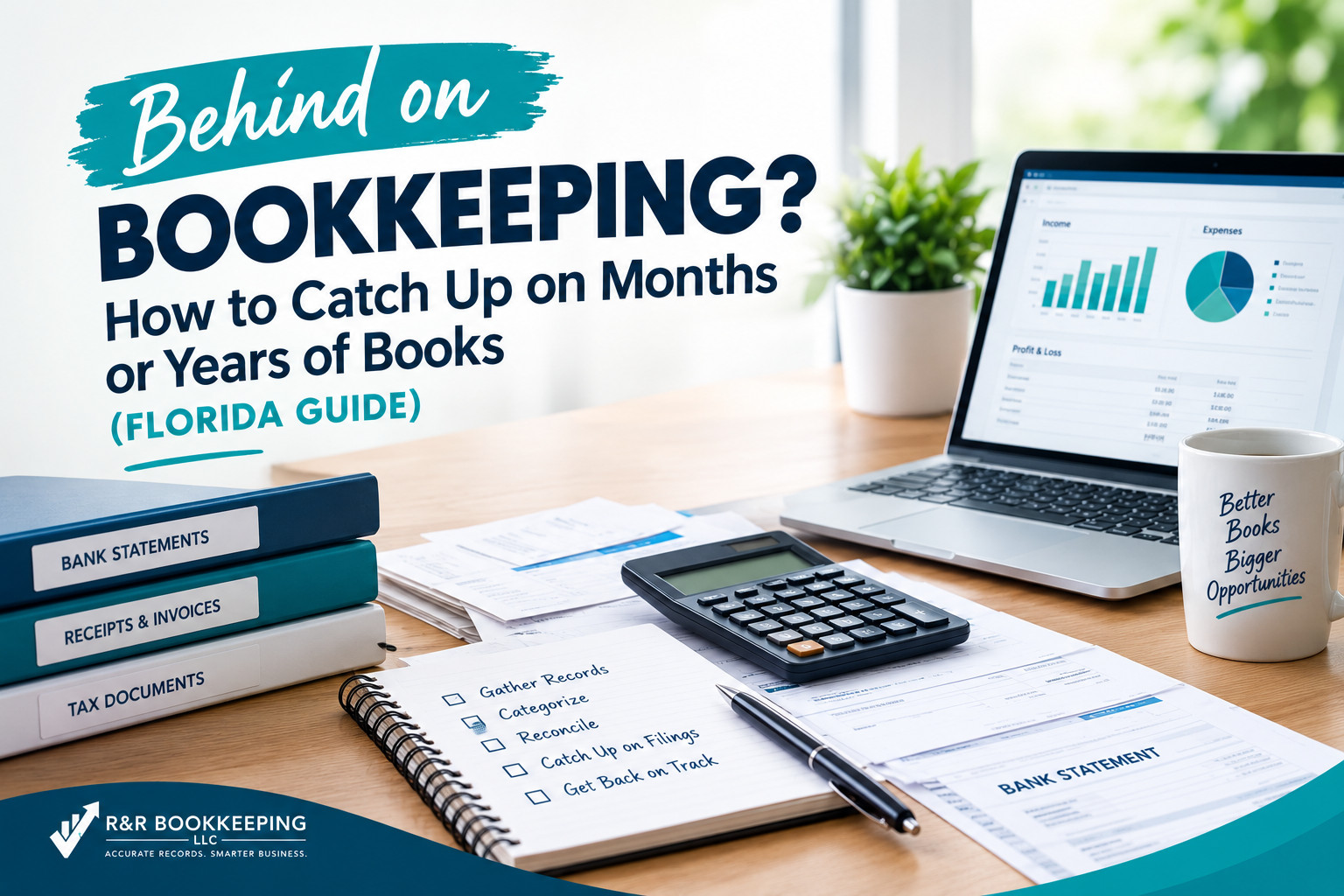
To catch up on bookkeeping, gather every bank, credit card, loan, and payroll statement for the missing period, set up or open your accounting software with correct opening balances, import and categorize transactions from oldest to newest, reconcile each account month by month, and then review your profit and loss statement and balance sheet for errors. Once you’re current, filings like payroll tax, Florida sales tax, 1099s, and your income tax return can be completed accurately. Most businesses that are a few months behind can catch up in days, while multi-year backlogs take weeks.
If you’ve fallen behind, you’re not alone, and it’s more fixable than it feels. Busy owners fall behind for ordinary reasons: a rush season, a bookkeeper who left, or a system that was never set up properly. This guide walks through exactly how to catch up on bookkeeping step by step, what it costs you to wait, and when it makes sense to bring in help, with notes specific to Florida businesses.
How Do You Know If You’re Behind on Bookkeeping?
You’re likely behind if any of these sound familiar:
- Your bank accounts haven’t been reconciled in more than a month
- Your accounting software shows hundreds of uncategorized transactions
- You don’t know your profit for last month or last quarter
- You’ve been putting receipts in a drawer, folder, or glove box “for later”
- You’ve missed or nearly missed a payroll, sales tax, or 1099 deadline
- Your accountant has asked for records you can’t produce quickly
Being a month behind is a small problem. Being a year or more behind is a bigger one, but the process for fixing both is the same.
Why Does Falling Behind on Bookkeeping Cost You Money?
Delay has a real price. Behind books can lead to:
- Missed deductions, because expenses you can’t document are expenses you can’t claim
- Late filing penalties, since the IRS charges a penalty for each month a return is late, and Florida charges penalties and interest on late sales tax returns
- Bad decisions, since you can’t price, hire, or invest well without knowing your numbers
- Loan and credit problems, because lenders typically ask for current financial statements
- Higher cleanup costs, since a larger backlog takes longer to fix
You can read the IRS’s current rules on the failure-to-file penalty to see how quickly late returns add up. The sooner your books are current, the smaller these problems stay.
How Do You Catch Up on Bookkeeping? A Step-by-Step Process
Step 1: Pick a Starting Point
Decide the first month you need to fix. If you’re unsure, start with the beginning of the current tax year, or the last month you know was reconciled correctly. Then decide to keep your current month on track from today forward so the backlog stops growing.
Step 2: Gather Your Documents
Collect everything for the missing period:
- Bank statements for every business account
- Credit card statements
- Loan and line-of-credit statements
- Payroll reports and payroll tax filings
- Sales tax returns, if you collect Florida sales tax
- Invoices, receipts, and contracts
- Prior-year tax return and any 1099s received
If statements are missing, most banks and card issuers let you download or request past statements, though how far back they go varies by institution. Request them early, because this is often the slowest step.
Step 3: Set Up Your Accounting Software Correctly
Open your QuickBooks file, or create one, and confirm the opening balances match your last reliable statement. Wrong opening balances are one of the most common reasons a catch-up never quite balances. If you’re still on an older desktop version, read our guide to QuickBooks Desktop to QuickBooks Online migration before you invest time in a file that’s being phased out.
Step 4: Import Your Transactions
Connect your bank feeds or upload statement files so transactions flow in automatically instead of being typed by hand. Check for duplicates when the feed overlaps with transactions you’ve already entered.
Step 5: Categorize From Oldest to Newest
Work chronologically, one month at a time. Assign each transaction to the right account, and flag anything you don’t recognize rather than guessing. If you’re unsure which category an expense belongs in, our guide to how to categorize business expenses lists the standard categories most small businesses use.
Step 6: Reconcile Each Account, Month by Month
Reconciliation matches your books to your actual bank and credit card statements. Do it for every account, every month, before moving to the next. If a month won’t balance, stop and find the cause, because errors compound as you move forward.
Step 7: Catch Up on Filings
Once the numbers are reliable, check what’s outstanding:
- Payroll tax filings, including quarterly and year-end forms, covered in our payroll services guide
- Florida sales tax returns, with deadlines and penalties explained in our Florida sales tax filing guide
- 1099s for contractors, summarized in our 1099 filing guide
- Federal income tax returns and any estimated tax payments
Step 8: Review Your Reports
Run the profit and loss statement, balance sheet, and trial balance for each period. Compare ending bank balances in your software to the real statements. Look for unusually large uncategorized balances, negative inventory, or expenses that don’t match what you remember. Our guide on how to read a profit and loss statement shows what to look for.
Step 9: Build a Monthly Routine
Catching up is only worthwhile if you stay caught up. Set a recurring time each month to categorize transactions, reconcile accounts, and review reports. Many owners find that a fixed monthly routine, or handing it to a bookkeeper, is the difference between never falling behind again and repeating the same cleanup next year.
How Long Does It Take to Catch Up on Bookkeeping?
The time depends on how far behind you are, how many transactions you have, and how organized your documents are. These are typical ranges, not guarantees:
| How Far Behind | Typical Timeline |
|---|---|
| 1 to 3 months, low transaction volume | A few days |
| 4 to 12 months | 1 to 2 weeks |
| More than 1 year, or high transaction volume | 2 to 4 weeks or more |
| Multiple years with missing statements | Varies, often longer |
Missing records, unreconciled history, and mixed personal and business spending all add time.
What If You’re Missing Receipts or Statements?
This is the most common obstacle, and it’s rarely fatal. Your bank and card statements are your primary record, so every payment still shows up there. For missing receipts:
- Use the bank record as the source, and note the business purpose in your software
- Request duplicate invoices from vendors
- Check email accounts for digital receipts
- Keep a written note for anything you can’t fully document
The IRS generally expects businesses to keep records that support their income and deductions. Its recordkeeping guidelines explain what to keep and for how long.
Can You Catch Up on Bookkeeping Yourself, or Should You Hire Help?
Both are realistic. Compare your options:
| Do It Yourself | Hire a Professional | |
|---|---|---|
| Best for | A few months behind, simple finances | A year or more behind, payroll, inventory, or sales tax |
| Cost | Your time, which is often the larger cost | A fee based on months and transaction volume |
| Risk of errors | Higher | Lower |
| Speed | Slower, competes with running the business | Faster, dedicated time |
Consider getting help if you’re more than three months behind, you have payroll or sales tax to untangle, tax season is close, or you’ve started and stalled more than once. Our QuickBooks clean up and catch up services are built for exactly this situation, and once you’re current, monthly bookkeeping services keep you from falling behind again.
What Should Florida Businesses Watch For?
A few Florida-specific points matter when you’re catching up:
- Sales tax comes first. If you collect Florida sales tax, unfiled returns accrue penalties, so confirm your filing status early.
- No state personal income tax, but federal returns and estimated payments still apply, as covered in our quarterly estimated taxes guide.
- Hurricane season makes digital records worth the effort. Scan paper receipts and store statements in the cloud so a storm can’t erase them.
- Q4 is a good time to catch up. Finishing before year-end lets you use our year-end bookkeeping checklist to close the year cleanly, and gives you clear numbers for cash flow planning.
Frequently Asked Questions
How do I catch up on bookkeeping? Gather all statements and records for the missing period, set correct opening balances, import and categorize transactions oldest to newest, reconcile each account monthly, then review your financial reports and complete any overdue filings.
How far behind can bookkeeping be and still be fixed? There’s generally no limit, as long as you can obtain bank and card statements to rebuild the records. Longer backlogs simply take more time.
How long does it take to catch up on bookkeeping? A few months can take days, a full year often takes one to two weeks, and multiple years can take several weeks or more, depending on volume and record quality.
What documents do I need to catch up on bookkeeping? Bank statements, credit card statements, loan statements, payroll reports, sales tax returns, invoices, receipts, and your prior tax return.
Can I catch up on bookkeeping if I’m missing receipts? Yes. Use your bank and card statements as the primary record, and add notes for the business purpose of each expense.
What’s the difference between bookkeeping catch-up and clean up? Catch-up means recording and reconciling periods that were never done. Clean up means correcting records that exist but contain errors. Many businesses need both at once.
Should I catch up before filing my taxes? Yes. Filing from accurate books reduces errors, missed deductions, and the risk of needing to amend later.
Is it worth hiring someone to catch up my books? Often yes, if you’re more than a few months behind or have payroll or sales tax involved, because professional help is faster and reduces the risk of costly mistakes.
What happens if I don’t catch up on my bookkeeping? You risk late-filing penalties, missed deductions, poor decisions, and difficulty getting financing, and the backlog gets larger and more expensive to fix over time.
Ready to Get Your Books Current?
You don’t have to dig out alone. Book a free consultation with our Sanford, FL team to review how far behind you are and get a clear plan, or visit our homepage to learn more.