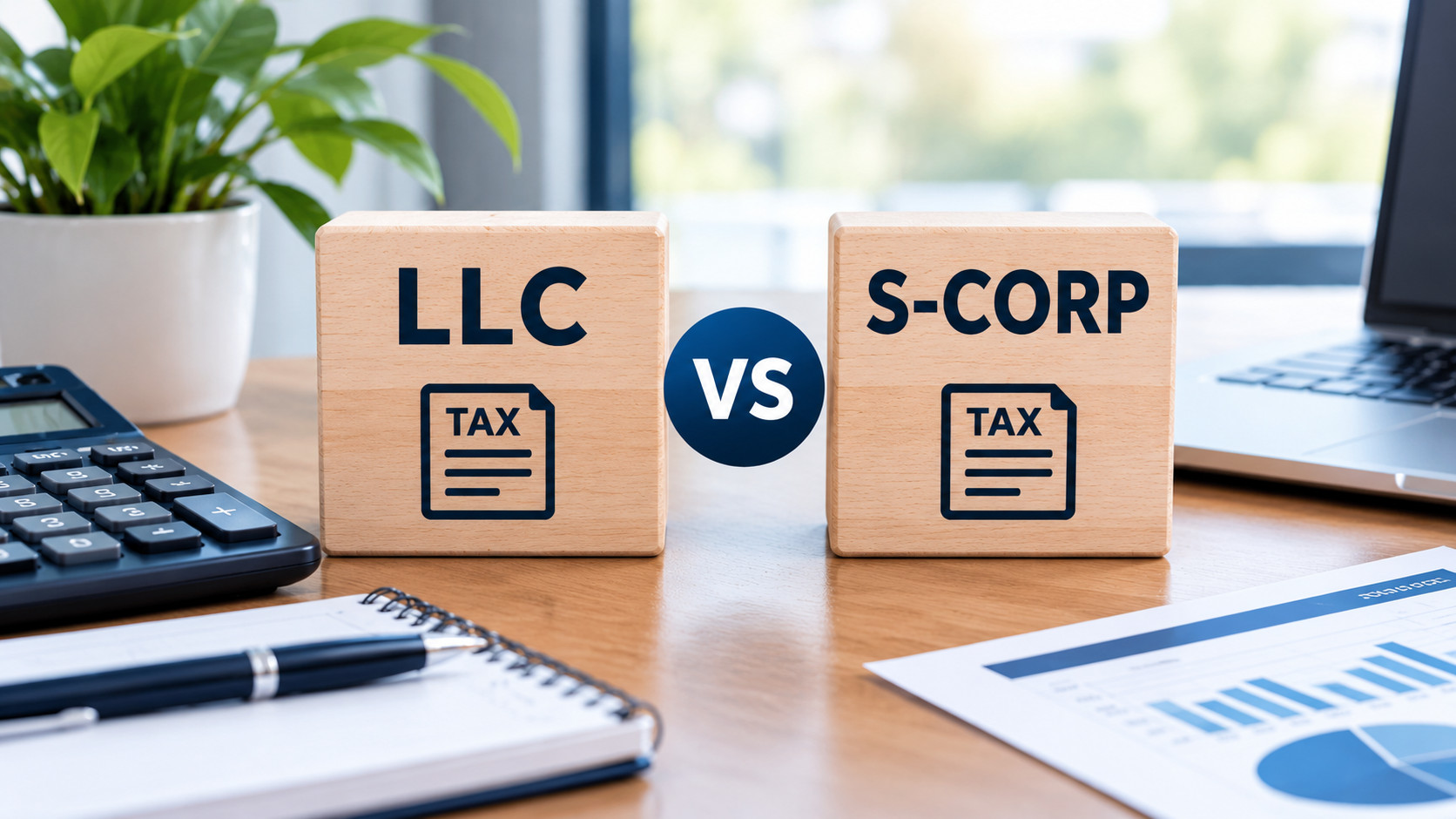
An LLC and an S-corp are taxed differently: a standard LLC’s profit is subject to self-employment tax (15.3%) on the full amount, while an S-corp lets the owner split income into a salary (subject to payroll tax) and a distribution (not subject to self-employment tax), which can lower the overall tax bill once profit reaches roughly $50,000–$80,000 or more per year. Below that threshold, the extra administrative cost of an S-corp often outweighs the tax savings.
This is one of the most common questions small business owners ask once their business starts generating real profit. The right answer depends less on which structure sounds better and more on your actual numbers. Here’s how the tax treatment really works.
How LLC Taxes Work
By default, a single-member LLC is taxed as a sole proprietorship, and a multi-member LLC is taxed as a partnership. In both cases, profit passes through to the owner’s personal tax return, and the entire net profit is subject to self-employment tax — 15.3%, covering Social Security and Medicare — in addition to regular income tax.
This is simple to manage, but it means every dollar of profit is taxed the same way, whether you’re actively working in the business or not.
How S-Corp Taxes Work
An S-corp isn’t a separate legal entity type — it’s a tax election. An LLC (or a corporation) can elect to be taxed as an S-corp with the IRS. Once elected, the owner becomes an employee of the business and must be paid a “reasonable salary,” which is subject to payroll tax. Any remaining profit can be distributed to the owner as a distribution, which is not subject to self-employment tax.
This split is where the tax savings come from: only the salary portion is taxed at the 15.3% self-employment/payroll tax rate, while the distribution portion avoids it entirely.
LLC vs S-Corp: Side-by-Side Tax Comparison
Here’s a simplified example at $100,000 in net business profit:
| LLC (Default) | S-Corp Election | |
|---|---|---|
| Total profit | $100,000 | $100,000 |
| Subject to self-employment/payroll tax | $100,000 | $50,000 (example salary) |
| Self-employment/payroll tax (15.3%) | ~$15,300 | ~$7,650 |
| Approximate tax savings | — | ~$7,650 |
This is a simplified illustration. Actual savings depend on your specific salary determination, state requirements, and additional S-corp administrative costs.
When an S-Corp Election Makes Sense
An S-corp election generally starts making financial sense when:
- Net business profit consistently exceeds roughly $50,000–$80,000 per year
- The business has predictable, ongoing profit (not just a one-time good year)
- The owner is comfortable running payroll and paying themselves a formal salary
- The tax savings outweigh the added cost of payroll processing and additional tax filings
Below that profit range, the administrative costs of an S-corp — payroll processing, additional tax return complexity, and stricter compliance requirements — often cost more than the tax savings generate.
The Hidden Costs of an S-Corp
An S-corp isn’t free to maintain. Costs to factor in include:
- Payroll processing — the owner must be run through payroll like any employee, which has its own cost
- Additional tax return — S-corps file a separate business tax return (Form 1120-S), which typically costs more in tax preparation fees than a simple pass-through LLC return
- Reasonable salary requirement — the IRS requires the salary portion to be “reasonable” for the work performed, and setting it too low to maximize distributions can trigger an audit risk
- State-level fees — some states charge additional fees or franchise taxes for S-corps
These costs typically run $1,500–$3,000+ per year combined, which is why the profit threshold matters — below it, the math often doesn’t favor making the switch.
How to Elect S-Corp Status
- Confirm your LLC or corporation is eligible (generally, U.S.-based, 100 or fewer shareholders, one class of stock)
- File Form 2553 with the IRS within the required timeframe (generally within 75 days of formation or the start of the tax year you want the election to apply to)
- Set up payroll to pay yourself a reasonable salary
- Begin tracking salary and distributions separately for accurate tax filing
Getting the salary determination and ongoing bookkeeping right is where most S-corp tax savings are won or lost — an S-corp only saves money if it’s set up and maintained correctly.
Is an S-Corp Election Right for Your Business?
The right answer depends entirely on your actual profit numbers, not a general rule of thumb. Before electing S-corp status, it’s worth running the real numbers for your specific business. See our Business Entity Tax Filing Services or Tax Planning Services to see how we help Sanford-area business owners make this decision with real numbers, or browse our full range of services.
For official guidance on eligibility and filing, see the IRS S Corporation guidelines.
Frequently Asked Questions
Is an S-corp better than an LLC for taxes? It depends on profit level. An S-corp election can reduce self-employment tax once profit consistently exceeds roughly $50,000–$80,000 per year, but below that, the added administrative costs often outweigh the tax savings.
How much can I save with an S-corp election? Savings come from paying self-employment/payroll tax only on the salary portion of income, not distributions. At $100,000 in profit with a $50,000 salary, this can save roughly $7,000+ per year, though actual savings vary by situation.
Do I need to change my LLC to elect S-corp status? No. Your LLC remains an LLC legally — the S-corp election only changes how it’s taxed by the IRS, filed using Form 2553.
What is a “reasonable salary” for an S-corp owner? It’s the amount the IRS expects you’d pay someone else to do your role, based on industry standards, experience, and time devoted to the business. Setting it too low relative to distributions can trigger IRS scrutiny.
When should I elect S-corp status? Form 2553 generally must be filed within 75 days of forming the LLC or within 75 days of the start of the tax year you want the election to apply to, though late election relief is sometimes available.
Not Sure Which Structure Fits Your Business?
The right answer depends on your specific numbers, not general advice. Book a free consultation with our Sanford, FL team to run the numbers for your business, or visit our homepage to learn more.