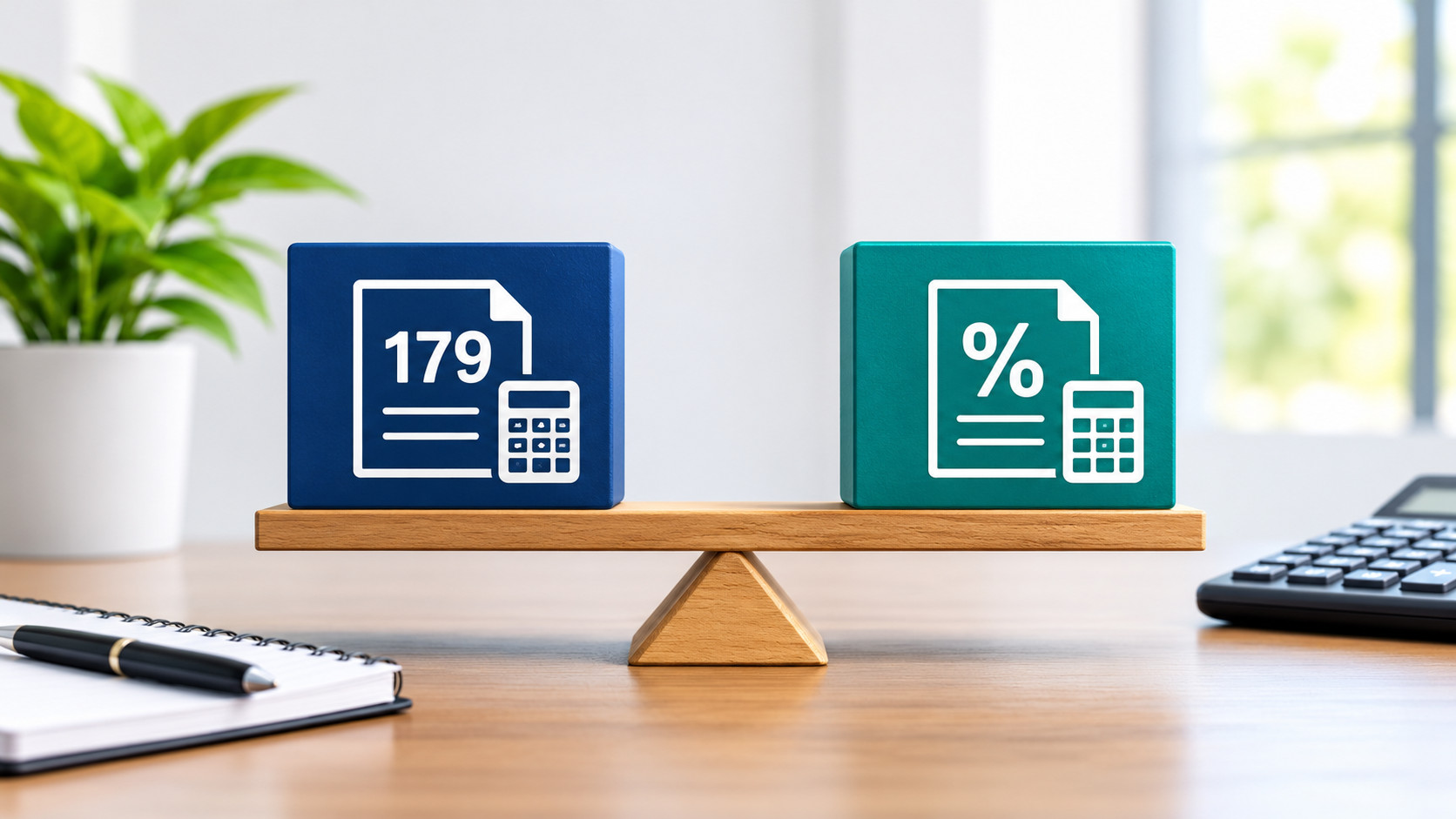
For 2026, Section 179 lets you deduct up to $2,560,000 of qualifying equipment in the year you place it in service, while 100% bonus depreciation lets you deduct the full cost of qualifying property with no dollar cap. The key differences: Section 179 is limited by your business income and can’t create a loss, while bonus depreciation has no income limit and can. Both generally require the equipment to be bought and placed in service by December 31, 2026, which makes this a Q4 decision.
If you’re thinking about buying equipment, a vehicle, or machinery before year-end, these two deductions are the biggest reason many owners buy now instead of in January. This guide explains how each works, how they differ, and how to choose, including the numbers you need for 2026 and the new 2027 limit.
What Is Section 179?
Section 179 is an election that lets you treat the cost of qualifying business property as an expense in the year you place it in service, instead of depreciating it over several years. For 2026, the maximum deduction is $2,560,000. The benefit begins to phase out once your total qualifying purchases for the year exceed $4,090,000, which means it’s aimed mostly at small and mid-size businesses.
What Is Bonus Depreciation?
Bonus depreciation is a first-year deduction for a percentage of qualifying property’s cost. Under the One Big Beautiful Bill Act, 100% bonus depreciation is permanent for qualifying property acquired after January 19, 2025. Unlike Section 179, it has no dollar cap and no phase-out. Our OBBBA tax changes guide explains how the law changed it.
How Do Section 179 and Bonus Depreciation Compare?
| Section 179 | Bonus Depreciation | |
|---|---|---|
| 2026 limit | $2,560,000 | No dollar limit |
| Phase-out | Begins above $4,090,000 of purchases | None |
| Limited by business income? | Yes | No |
| Can create a loss? | No | Yes, potentially a net operating loss |
| Choose asset by asset? | Yes | Applies to the whole asset class unless you opt out |
| Deadline | Placed in service by December 31 | Placed in service by December 31 |
What Property Qualifies?
Generally, both apply to tangible business property you use more than half the time for business, such as machinery, equipment, furniture, computers, and certain vehicles. Land and buildings themselves don’t qualify, though some qualifying improvements to existing buildings can be eligible for Section 179. Used equipment can qualify as long as it’s new to you.
What About Vehicles?
Vehicles have special rules. For 2026, the Section 179 limit for certain SUVs is $32,000, and it rises to $33,100 for 2027. Passenger cars have separate annual depreciation caps. Because vehicle rules are detailed, confirm your specific vehicle’s weight rating and business use with a tax professional before buying.
How Do You Choose Between Them?
Here’s a practical way to think about it:
- If your business income is lower than your planned purchases, Section 179 is limited, so bonus depreciation may allow a larger deduction.
- If you want to control exactly which assets are expensed, Section 179 lets you choose asset by asset.
- If you want to avoid a loss or manage your taxable income, you can use Section 179 for some assets and depreciate others normally.
- If your state doesn’t follow federal rules, your state treatment may differ. Florida has no personal income tax, but Florida corporate filers should confirm their state treatment.
Many owners use both together, applying Section 179 first and bonus depreciation to the rest.
What Mistakes Should You Avoid?
- Buying equipment only for the deduction. A deduction reduces your tax by only part of the cost, and you still spend the rest.
- Missing the in-service date. Property must be ready and available for use by December 31, not just purchased.
- Expensing equipment in the wrong account. Equipment should be recorded as a fixed asset, not a regular expense.
- Weak records. Keep invoices, purchase dates, and in-service dates.
- Ignoring cash flow. Financing is allowed, but payments still hit your cash, so review our cash flow management guide first.
- Forgetting business-use percentage, especially for vehicles.
What Is the 2027 Section 179 Limit?
The IRS announced that the 2027 Section 179 limit will be $2,640,000, up from $2,560,000, with an SUV limit of $33,100. These apply to property placed in service in 2027, not 2026. Our guide to the 2027 tax brackets and inflation adjustments covers the full announcement.
How Should You Record Equipment Purchases in Your Books?
Record equipment as a fixed asset on your balance sheet, then record the depreciation or Section 179 deduction according to your tax preparer’s schedule. Keep a fixed asset list showing the purchase date, cost, in-service date, and business-use percentage. Misrecording purchases as ordinary expenses can distort your profit, as our P&L guide explains, and our guide to how to categorize business expenses shows where equipment belongs.
What Should You Do Before December 31?
- Decide what equipment you actually need
- Estimate your 2026 profit, using reconciled books
- Talk to your tax professional about Section 179 versus bonus depreciation
- Buy and place the equipment in service before year-end
- Save invoices and in-service documentation
- Update your fixed asset records
Our year-end tax planning guide and tax deductions guide cover the rest of your Q4 checklist.
Get Help Making the Right Choice
The right answer depends on your income, your purchases, and your plans. Our Tax Planning Services help Sanford and Central Florida owners run the numbers before they buy, our monthly bookkeeping services keep asset records accurate, and you can browse our full range of services.
For the official rules, see IRS Publication 946, How to Depreciate Property.
Frequently Asked Questions
What is the Section 179 limit for 2026? $2,560,000, with the benefit phasing out above $4,090,000 of qualifying purchases.
Is 100% bonus depreciation available in 2026? Yes. It’s permanent for qualifying property acquired after January 19, 2025.
What’s the difference between Section 179 and bonus depreciation? Section 179 has a dollar limit and is limited by business income. Bonus depreciation has no dollar limit and can create a loss.
Can I use both Section 179 and bonus depreciation? Yes. Many businesses apply Section 179 first and bonus depreciation to the remainder.
What equipment qualifies? Generally, tangible business property such as machinery, equipment, computers, and furniture used more than half the time for business.
Does used equipment qualify? Yes, if it’s new to you and meets the other requirements.
What’s the Section 179 limit for SUVs in 2026? $32,000 for certain SUVs, rising to $33,100 in 2027.
What is the Section 179 limit for 2027? $2,640,000.
Do I have to buy equipment before December 31? To claim it for 2026, the equipment generally must be purchased and placed in service by December 31.
Can I finance the equipment and still deduct it? Generally yes. Financed equipment can qualify, but you still need cash flow for the payments.
Should I buy equipment just to save taxes? No. A deduction only offsets part of the cost, so buy equipment you actually need.
Does Florida follow federal depreciation rules? Florida has no personal income tax. Corporate filers should check Florida’s treatment of federal depreciation.
Make a Smart Equipment Decision Before Year-End
A short review of your numbers can save you from an expensive mistake. Book a free consultation with our Sanford, FL team, or visit our homepage to learn more.
This guide is general information, not tax or legal advice. Confirm your situation with a tax professional.