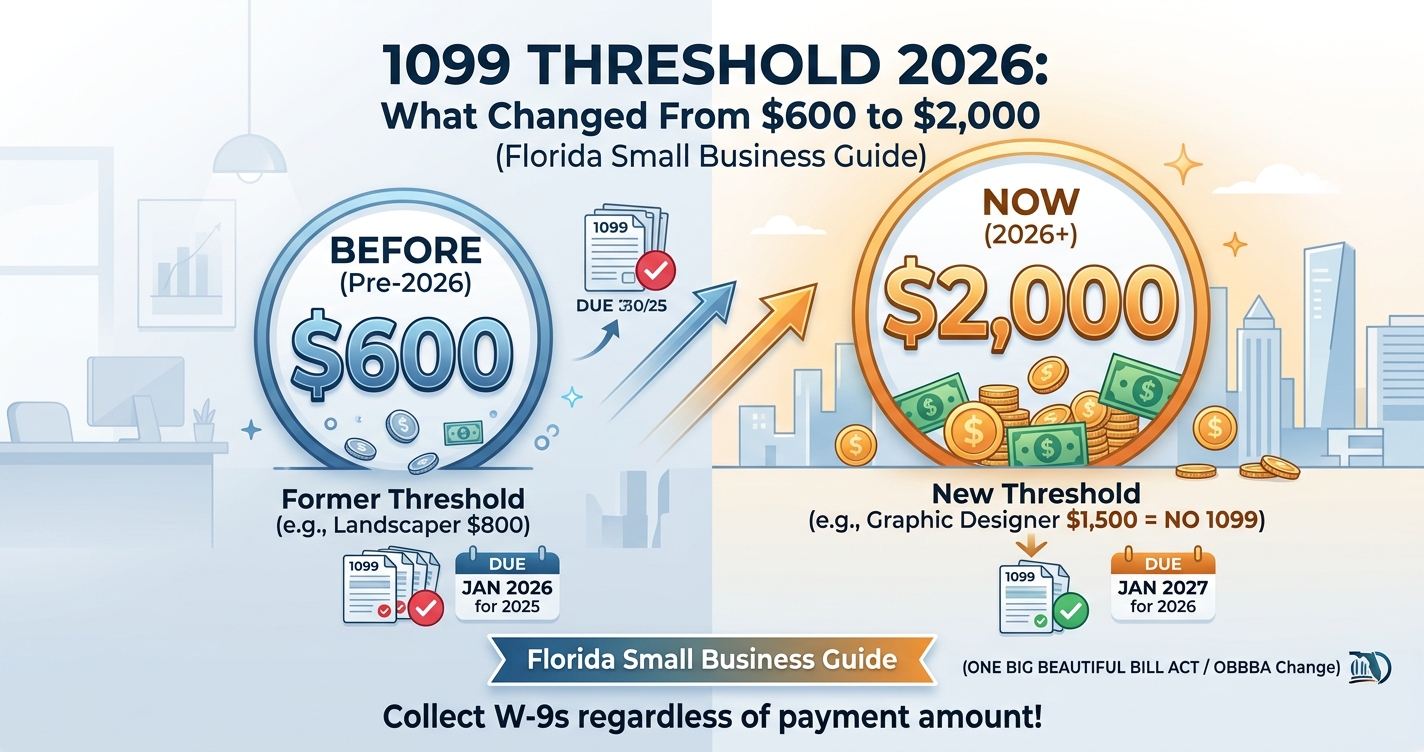
The 1099 threshold for 2026 is $2,000. For payments made on or after January 1, 2026, your business generally must file Form 1099-NEC or 1099-MISC only if you paid a contractor or vendor $2,000 or more during the year, up from the $600 threshold that had applied for decades. The change comes from the One Big Beautiful Bill Act (OBBBA). Forms for 2026 payments are due in early 2027, so this is the first year you’ll feel the difference, and the right time to review your records is now, in Q4.
If you own a business in Sanford, Orlando, or anywhere in Florida and you pay contractors, this change affects how you track payments, how many forms you file, and what you tell your contractors. Below is a plain-English guide to what changed, what didn’t, and what to do before year-end.
What Is the New 1099 Threshold for 2026?
The reporting threshold for Form 1099-NEC (nonemployee compensation) and most Form 1099-MISC payment types rose from $600 to $2,000 for payments made after December 31, 2025. Published guidance from CPA firms also notes that the threshold will be adjusted for inflation starting in 2027, so $2,000 won’t stay fixed forever.
The threshold is measured per contractor, per calendar year. If you pay a landscaper $1,200 in March and another $1,000 in October, that’s $2,200 for the year, so a 1099-NEC is required. If you pay a graphic designer $1,500 across the whole year, a 1099-NEC is no longer required.
Which Payments Use the Old $600 Threshold and Which Use $2,000?
The timing of the payment decides which threshold applies:
| Payments Made In | 1099-NEC / 1099-MISC Threshold | Forms Due |
|---|---|---|
| 2025 | $600 | January 2026 (already filed) |
| 2026 | $2,000 | Early 2027 |
Forms you filed earlier this year for 2025 payments followed the old $600 rule. The new $2,000 rule applies only to payments you make during 2026.
What Did NOT Change?
A few things stay the same, and mixing them up is where businesses get into trouble:
- Filing is still required once a contractor reaches the threshold. Missing a required form still carries per-form penalties that increase the longer a filing is late.
- You should still collect a W-9 from every contractor, even if payments stay under $2,000. Having a W-9 on file protects you if the amount grows or if a name or tax ID issue comes up later.
- Employees are still different. Workers who are really employees should be on W-2 payroll, regardless of dollar amount. Our guide to 1099 vs W-2 worker classification explains how the IRS decides.
- The deadline for 1099-NEC is unchanged. The form is due to both the contractor and the IRS by January 31 of the following year.
- You still need to track every payment. Even if you don’t file for a contractor this year, their total could cross the threshold next year, and the threshold itself will move.
What About the 1099-K Threshold?
The 1099-K is a different form, issued by payment platforms such as PayPal, Venmo, Stripe, and Square, not by you. OBBBA separately restored the 1099-K reporting threshold to $20,000 and more than 200 transactions, rolling back the lower thresholds that had been phasing in. If a contractor is paid through a card or payment platform, the platform generally reports that income on a 1099-K, so you usually don’t issue a 1099-NEC for those payments.
When Is the 1099-NEC Due for 2026 Payments?
The 1099-NEC deadline for 2026 payments is January 31, 2027. That date falls on a Sunday, so the due date moves to the next business day, Monday, February 1, 2027. Plan to finish earlier anyway. January is also when estimated taxes, year-end payroll, and W-2s are due, so filing early keeps you out of a crunch. Our 1099 filing deadlines guide covers the full schedule.
Businesses that file 10 or more information returns in total generally must file electronically, so confirm your filing method early rather than in late January.
Does Florida Have Its Own 1099 Threshold?
Florida has no state personal income tax, so most Florida businesses are only dealing with the federal rules. If you pay contractors who live in other states, however, those states may have their own reporting rules, and some have not yet aligned with the new federal threshold. When you pay out-of-state contractors, confirm the requirements with a tax professional before assuming the federal threshold is the only one that matters.
What Should Florida Businesses Do Before Year-End?
Use Q4 to get ahead of the new rule. Work through this checklist:
- Pull a year-to-date report of every contractor and vendor you’ve paid in 2026
- Identify who has reached or will reach $2,000 by December 31
- Collect a W-9 from every contractor who doesn’t have one on file
- Check names, addresses, and tax ID numbers so forms aren’t rejected
- Separate contractors from employees, and fix any misclassifications now
- Separate payments made by card or payment platform, since those are reported by the platform on a 1099-K
- Check your accounting software’s 1099 settings, since some tools needed updates for the new threshold
- Reconcile your accounts, so the payment totals are reliable
- Decide who will file, and when
Accurate totals depend on accurate books. If you’re behind, our guide on how to catch up on bookkeeping walks through fixing the backlog, and our year-end bookkeeping checklist shows what to have ready before January.
How Do You Track Contractor Payments Correctly?
The easiest way to avoid a January scramble is to track contractor payments all year:
- Record each contractor as a vendor, with a W-9 and the 1099 option turned on
- Pay contractors by check or bank transfer, so payments are easy to total
- Categorize payments consistently, as covered in our guide to how to categorize business expenses
- Review contractor totals every quarter, not just in December
If your file is messy, a QuickBooks clean up and catch up can fix miscategorized vendor payments and missing W-9 information before filing season. For ongoing tracking, our monthly bookkeeping services keep contractor totals current all year.
How Does the New Threshold Connect to Other OBBBA Changes?
The 1099 change is one of several small business provisions in the same law, including bonus depreciation, expanded Section 179 expensing, and a permanent qualified business income deduction. Our OBBBA small business tax changes guide covers the rest, and our small business tax deductions guide shows how to put them to use before December 31.
Get Help Filing 1099s the Right Way
Fewer forms doesn’t mean no work. You still need accurate totals, valid W-9s, and correct filings. See our 1099 Filing Services to learn how we help Sanford and Central Florida businesses stay compliant, or browse our full range of services.
For the official rules, see the IRS page for Form 1099-NEC and the IRS page for Form W-9.
Frequently Asked Questions
What is the 1099 threshold for 2026? For payments made in 2026, the federal threshold for Form 1099-NEC and most Form 1099-MISC payment types is $2,000, up from $600.
When does the new $2,000 1099 threshold start? It applies to payments made on or after January 1, 2026. Forms for those payments are filed in early 2027.
Do I still need to file a 1099 for a contractor I paid $1,500 in 2026? Generally no, because $1,500 is below the $2,000 threshold. You should still keep the payment records and a W-9 on file.
Do I still need W-9 forms from contractors? Yes. Collecting a W-9 is still good practice for every contractor, since it protects you if payments grow or a tax ID mismatch comes up.
Was the 1099-K threshold also changed? Yes. The 1099-K threshold was restored to $20,000 and more than 200 transactions. It is separate from the 1099-NEC and 1099-MISC threshold.
What is the 1099-NEC due date for 2026 payments? The deadline is January 31, 2027, which falls on a Sunday, so it moves to Monday, February 1, 2027.
Does Florida require its own 1099 filing? Florida has no state personal income tax, so most Florida businesses follow the federal rules. If you pay contractors in other states, check those states’ requirements.
Will the $2,000 threshold change again? Yes. Published guidance indicates it will be adjusted for inflation beginning in 2027, so don’t assume $2,000 is permanent.
What happens if I miss a required 1099 filing? The IRS charges per-form penalties that increase the later you file, so file on time and correct mistakes quickly.
Should I still track payments under $2,000? Yes. Totals can add up across the year, and the threshold may change, so tracking every payment keeps you ready.
Not Sure Which Contractors Need a 1099 This Year?
A quick review of your books now can save a scramble in January. Book a free consultation with our Sanford, FL team, or visit our homepage to learn more.