
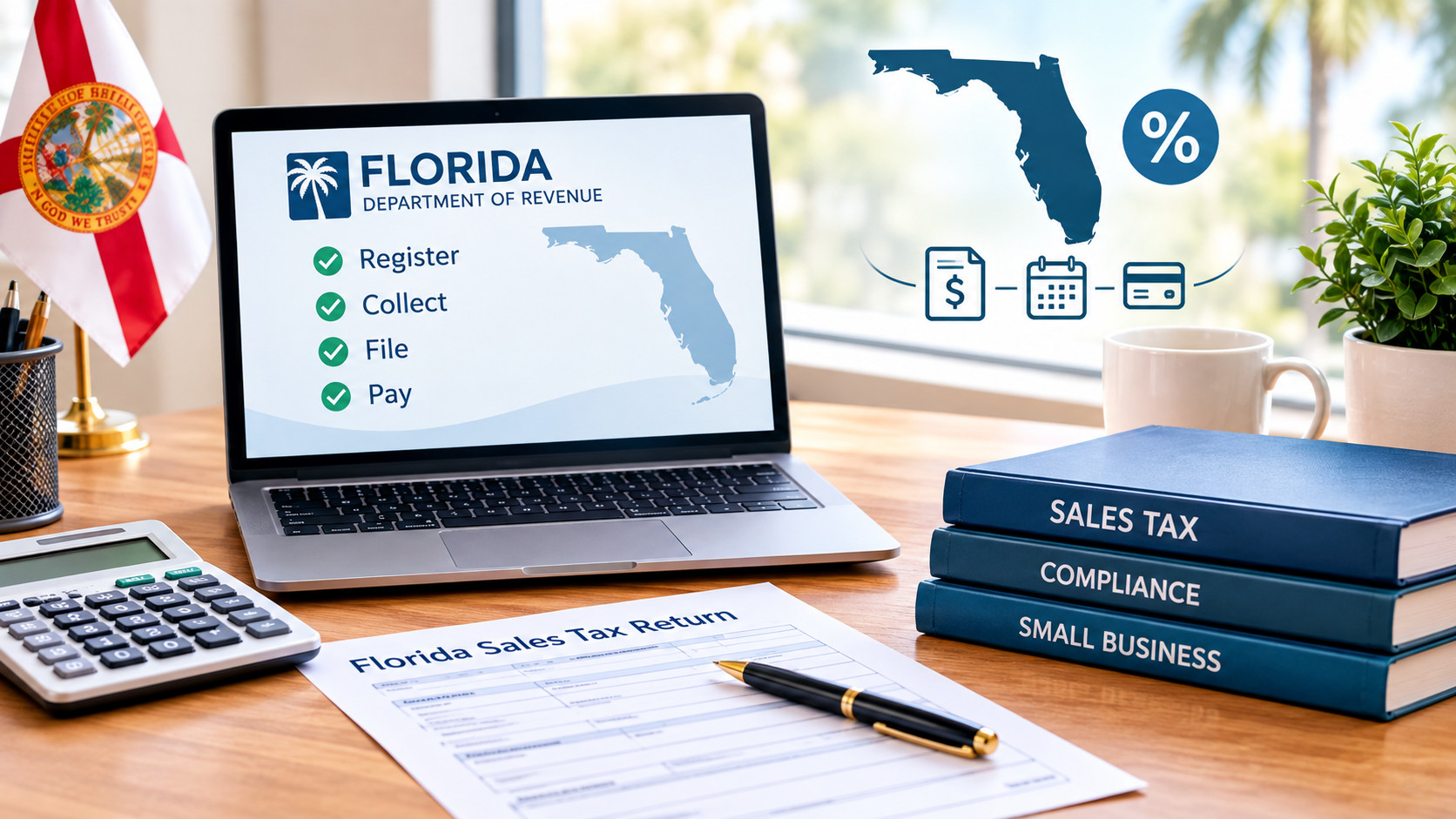
Florida sales tax filing requires registering with the Florida Department of Revenue, collecting the correct sales tax rate for each transaction (6% state rate plus any local surtax), and filing returns by the assigned deadline — monthly, quarterly, or annually, depending on your business’s sales volume. Missing a Florida sales tax filing deadline results in penalties starting at 10% of the tax due, so knowing your exact filing schedule matters.
If you sell taxable goods or certain services in Florida, sales tax filing isn’t optional, and the rules trip up a lot of small business owners — especially around local surtax rates, which vary by county. Here’s a complete, step-by-step breakdown.
Who Needs to File Florida Sales Tax
You generally need to register and file Florida sales tax if your business:
- Sells tangible personal property (physical goods) in Florida
- Provides certain taxable services (commercial rentals, some repair services)
- Operates a retail location, e-commerce store, or physical presence in Florida
- Has economic nexus in Florida through remote sales exceeding state thresholds
Most service-based businesses without a taxable product don’t need to collect sales tax, but many hybrid businesses (a consultant who also sells products, for example) do need to file for the taxable portion of their sales.
How to Register for a Florida Sales Tax Account
Before you can legally collect sales tax, you need a Florida sales tax certificate:
- Go to the Florida Department of Revenue’s business registration portal
- Register your business and receive a sales tax certificate number
- Determine your assigned filing frequency (monthly, quarterly, or annual)
- Set up your sales tax collection in your point-of-sale system or invoicing software
Once registered, you’re required to display your sales tax certificate at your business location if you have a physical storefront.
Florida Sales Tax Rates by County
Florida’s base state sales tax rate is 6%, but most counties add a local discretionary surtax on top of that, meaning your actual rate depends on where the sale takes place:
| County | Combined Sales Tax Rate |
|---|---|
| Seminole County | 7% |
| Orange County | 6.5% |
| Lake County | 7% |
| Volusia County | 6.5% |
| Osceola County | 7.5% |
Rates are subject to change. Always confirm current rates through the Florida Department of Revenue before filing, since counties can adjust discretionary surtax rates.
Businesses that sell across multiple Florida counties need to apply the correct combined rate for each transaction location, not a single flat rate statewide.
Florida Sales Tax Filing Deadlines
Your filing frequency is assigned by the Department of Revenue based on your sales tax liability, and each frequency has its own deadline pattern:
- Monthly filers: Return and payment due on the 20th of the following month
- Quarterly filers: Due the 20th of the month following the end of the quarter
- Annual filers: Due January 20th of the following year
Florida also offers a small collection allowance and early filing discount for businesses that file and pay on time, which is easy to miss if filings are rushed at the last minute.
How to File Your Florida Sales Tax Return
- Log into the Florida Department of Revenue’s online filing portal
- Report total sales, taxable sales, and exempt sales for the period
- Apply the correct combined tax rate for each county where sales occurred
- Submit payment electronically by the deadline
- Keep a copy of the filed return and confirmation for your records
Businesses with clean, up-to-date bookkeeping can pull these numbers directly from their records in minutes. Businesses without organized books often spend hours reconstructing sales data before they can even start the filing.
Penalties for Late Filing
Missing a Florida sales tax filing deadline triggers real financial consequences:
- 10% penalty of the tax due for late filing, with a minimum penalty even if no tax is owed
- Interest charges that accrue on unpaid tax from the due date until paid
- Loss of collection allowance for businesses that would have otherwise qualified for the early filing discount
Repeated late filings can also trigger closer review from the Department of Revenue, which is worth avoiding entirely by keeping filings on a consistent schedule.
Staying Ahead of Florida Sales Tax Filing
The businesses that struggle most with Florida sales tax filing are usually the ones trying to reconstruct sales records right before the deadline. Keeping sales data organized monthly makes filing take minutes instead of hours. See our Florida Sales Tax Filing Services or Monthly Bookkeeping Services to see how we keep Central Florida businesses filing accurately and on time, or browse our full range of services.
For official rate lookups and registration, visit the Florida Department of Revenue.
Frequently Asked Questions
What is the Florida sales tax rate? Florida’s base state sales tax rate is 6%, with most counties adding a local discretionary surtax that brings the combined rate to 6.5%–8%, depending on the county.
How often do I need to file Florida sales tax? Filing frequency is assigned by the Florida Department of Revenue based on your tax liability and is typically monthly, quarterly, or annually.
What happens if I file Florida sales tax late? Late Florida sales tax filings incur a 10% penalty of the tax due, plus accruing interest, and can result in the loss of any early filing collection allowance.
Do service-based businesses need to file Florida sales tax? Most services aren’t taxable in Florida, but certain services like commercial rentals and specific repair or maintenance services are. Businesses selling both products and services may need to file for the taxable portion only.
Can I file Florida sales tax myself, or do I need help? You can file it yourself through the Department of Revenue’s online portal, but many small businesses use a bookkeeper to ensure sales are tracked accurately by location and filed correctly and on time.
Need Help Staying Compliant with Florida Sales Tax?
Sales tax filing is one of the easiest compliance requirements to fall behind on without realizing it. Book a free consultation with our Sanford, FL team, or visit our homepage to learn more.