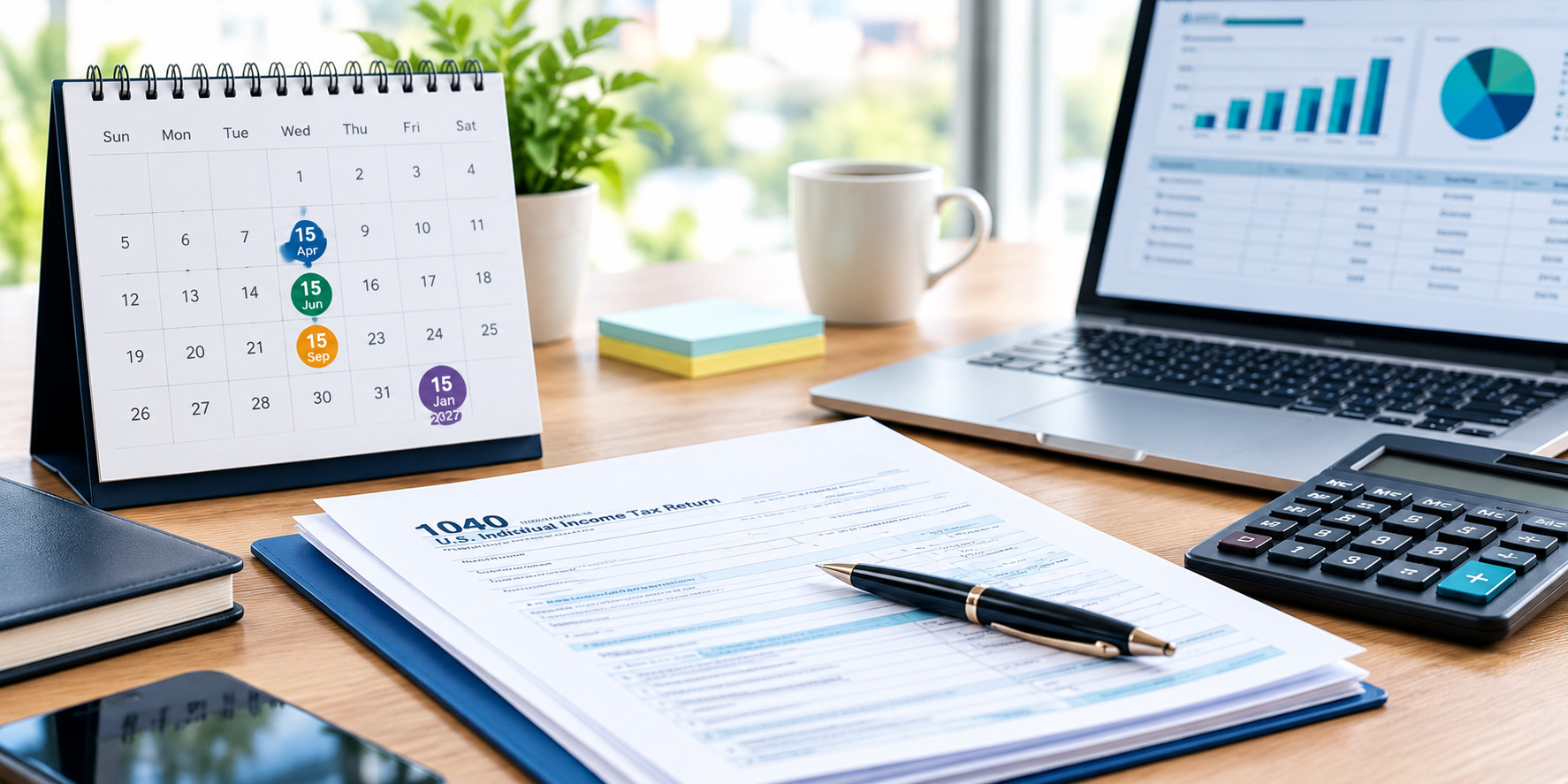
Quarterly estimated taxes are advance payments of income tax and self-employment tax that business owners make to the IRS four times a year, because no employer is withholding tax from their income. You generally need to pay them if you expect to owe $1,000 or more in federal tax for the year after subtracting withholding and credits. For tax year 2026, the four due dates are April 15, June 15, September 15, and January 15, 2027, and paying either 90% of your 2026 tax or 100% of your 2025 tax (110% if your 2025 adjusted gross income was over $150,000) protects you from underpayment penalties.
The U.S. tax system is pay-as-you-go. When you work for an employer, tax comes out of every paycheck automatically. When you own a business, nobody does that for you, so the IRS expects you to send payments throughout the year instead of one lump sum in April. This guide explains who has to pay, when each payment is due, and how to figure out the right amount without overpaying or triggering a penalty.
Who Has to Pay Quarterly Estimated Taxes?
You generally need to make estimated tax payments if you earn income that has no tax withheld and you expect to owe at least $1,000 when you file your return. That includes:
- Sole proprietors and single-member LLC owners
- Partners in a partnership and members of multi-member LLCs
- S-corporation shareholders whose income exceeds what payroll withholding covers
- Freelancers and independent contractors who receive 1099 income
- Anyone with significant rental, investment, or side-business income
If you’re an S-corp owner paying yourself a W-2 salary, withholding from that salary can count toward your estimated tax requirement, which is one reason the structure you choose matters. Our breakdown of LLC vs S-corp taxes explains how the two structures handle this differently.
2026 Quarterly Estimated Tax Deadlines
The IRS divides the year into four payment periods, and the due dates don’t line up with calendar quarters the way many people expect.
| Payment | Income Earned | Due Date |
|---|---|---|
| Q1 | January 1 – March 31, 2026 | April 15, 2026 |
| Q2 | April 1 – May 31, 2026 | June 15, 2026 |
| Q3 | June 1 – August 31, 2026 | September 15, 2026 |
| Q4 | September 1 – December 31, 2026 | January 15, 2027 |
When a due date falls on a weekend or federal holiday, it shifts to the next business day. Because the second period is only two months long, the Q2 deadline arrives faster than many owners expect.
If you’re reading this in October and haven’t made your Q3 payment, it’s still worth paying now. Penalties are calculated based on how much was underpaid and for how long, so paying late is better than not paying at all.
What Is the Safe Harbor Rule?
The safe harbor rules are your protection against the underpayment penalty. You avoid the penalty if you meet any one of these tests:
- Pay 90% of this year’s tax. Your withholding plus estimated payments cover at least 90% of the total tax you’ll owe for 2026.
- Pay 100% of last year’s tax. Your payments equal at least 100% of the total tax shown on your 2025 return. If your 2025 adjusted gross income was more than $150,000 ($75,000 if married filing separately), this rises to 110%.
- Owe less than $1,000. If the balance due at filing is under $1,000 after withholding and credits, no penalty applies.
For most business owners with variable income, the prior-year method is the easiest because the number is already fixed. Take the total tax from your 2025 return, multiply by 100% or 110%, divide by four, and make four equal payments. You could still owe more in April if your income grows, but you won’t face an underpayment penalty for it.
How to Calculate Your Estimated Taxes
There are two practical approaches, depending on how predictable your income is.
Method 1: Prior-year safe harbor (simplest)
- Find the total tax line on your 2025 Form 1040
- Multiply by 100%, or 110% if your 2025 AGI exceeded $150,000
- Divide by four
- Pay that amount each quarter
Method 2: Current-year estimate (more accurate if income changed)
- Estimate your total 2026 net business profit
- Subtract deductions, including the qualified business income deduction if you qualify
- Calculate income tax using the current tax brackets
- Add self-employment tax, which is 15.3% on net earnings up to the Social Security wage base, with a lower Medicare portion above it
- Subtract any withholding or credits
- Divide the remainder by four
If your income dropped this year, Method 2 can mean smaller payments. If your income grew, Method 1 keeps you penalty-free even though the final bill may be larger. Many business owners also use the IRS Form 1040-ES worksheet to walk through the math.
Don’t Forget Self-Employment Tax
Most first-time estimated tax payers underestimate this part. Self-employment tax covers your Social Security and Medicare contributions, and because you’re both the employer and the employee, you pay both halves. It’s calculated on your net business profit and sits on top of regular income tax.
You do get to deduct half of your self-employment tax when calculating your adjusted gross income, which softens the impact slightly. Still, it’s common for a freelancer or sole proprietor to owe 25-35% of net profit between income tax and self-employment tax, depending on income level and deductions. Setting aside a percentage of every payment you receive is the easiest way to make sure the cash is there when each deadline arrives.
Florida Business Owners: What About State Estimated Taxes?
Florida has no state personal income tax, so Florida residents don’t make quarterly estimated payments to the state for personal income. That makes the federal calculation the main one for most sole proprietors and pass-through owners here.
Florida does impose a corporate income tax on C-corporations, and businesses that sell taxable goods have separate sales tax obligations, which follow their own schedule. Our guide to Florida sales tax filing covers those deadlines.
How Recent Tax Law Changes Affect Your Payments
The tax changes under the One Big Beautiful Bill Act affect how much many small business owners owe, including the permanent qualified business income deduction and expanded expensing for equipment purchases. If you made a large equipment purchase this year, your actual 2026 tax could be lower than last year’s, which may make the current-year method worth running. Our OBBBA small business tax changes guide walks through which provisions matter most.
How to Pay Quarterly Estimated Taxes
You have several options, and all of them leave a record for your books:
- IRS Direct Pay: Free, pulls directly from a checking or savings account
- EFTPS (Electronic Federal Tax Payment System): Useful if you want to schedule payments in advance
- IRS online account: Lets you view payment history and make payments
- Form 1040-ES voucher by mail: Still accepted, but slower and harder to confirm
Always save the confirmation number. When you record each payment in your bookkeeping software, categorize it correctly as an owner’s draw or tax payment rather than a business expense, since estimated tax payments are not deductible. Mistakes here are common, and they quietly distort your profit and loss statement. Our guide on how to categorize business expenses explains where payments like these belong.
What Happens If You Underpay?
If you miss a safe harbor, the IRS charges an underpayment penalty, calculated like interest on the amount you should have paid for each quarter you fell short. The rate is set quarterly by the IRS. You calculate it on Form 2210 when you file.
The penalty is not enormous in most cases, but it’s entirely avoidable, and it’s one more reason to review your payments before the final January deadline. Making a larger Q4 payment can help you reach the safe harbor target, which is why planning in the fourth quarter matters. Our year-end bookkeeping checklist shows how to get your records ready for exactly this kind of review.
Getting Help With Estimated Taxes
Estimated taxes are straightforward in concept and easy to get wrong in practice, especially when income moves around from month to month. A bookkeeper who keeps your profit and loss current can tell you what you owe at any point in the year instead of leaving you to guess. See our Tax Planning Services and Business Tax Preparation to see how we help Sanford and Central Florida business owners stay ahead of each deadline, or browse our full range of services.
Frequently Asked Questions
Who has to pay quarterly estimated taxes? Self-employed individuals, sole proprietors, partners, LLC members, and S-corp shareholders generally must pay if they expect to owe $1,000 or more in federal tax after withholding and credits.
When are quarterly estimated taxes due in 2026? The 2026 due dates are April 15, June 15, September 15, and January 15, 2027. Dates that land on a weekend or holiday move to the next business day.
How much should I pay each quarter? The simplest approach is to pay 100% of last year’s total tax divided by four, or 110% if last year’s adjusted gross income was over $150,000. Alternatively, pay at least 90% of your estimated 2026 tax.
What happens if I miss a quarterly estimated tax payment? The IRS may charge an underpayment penalty based on how much you underpaid and for how long. Paying late is still better than not paying, because the penalty stops growing once the shortfall is paid.
Do I pay estimated taxes in Florida? Florida has no state personal income tax, so you only make federal estimated payments for personal business income. C-corporations and businesses collecting sales tax have separate Florida obligations.
Are estimated tax payments tax deductible? No. Estimated payments are advance payments of your personal tax bill, not a business expense, so they should not be recorded as a deductible expense in your books.
Not Sure How Much You Should Be Paying?
Getting the amount right takes accurate books and a quick review of your numbers. Book a free consultation with our Sanford, FL team, or visit our homepage to learn more about how we help business owners stay compliant year-round.