
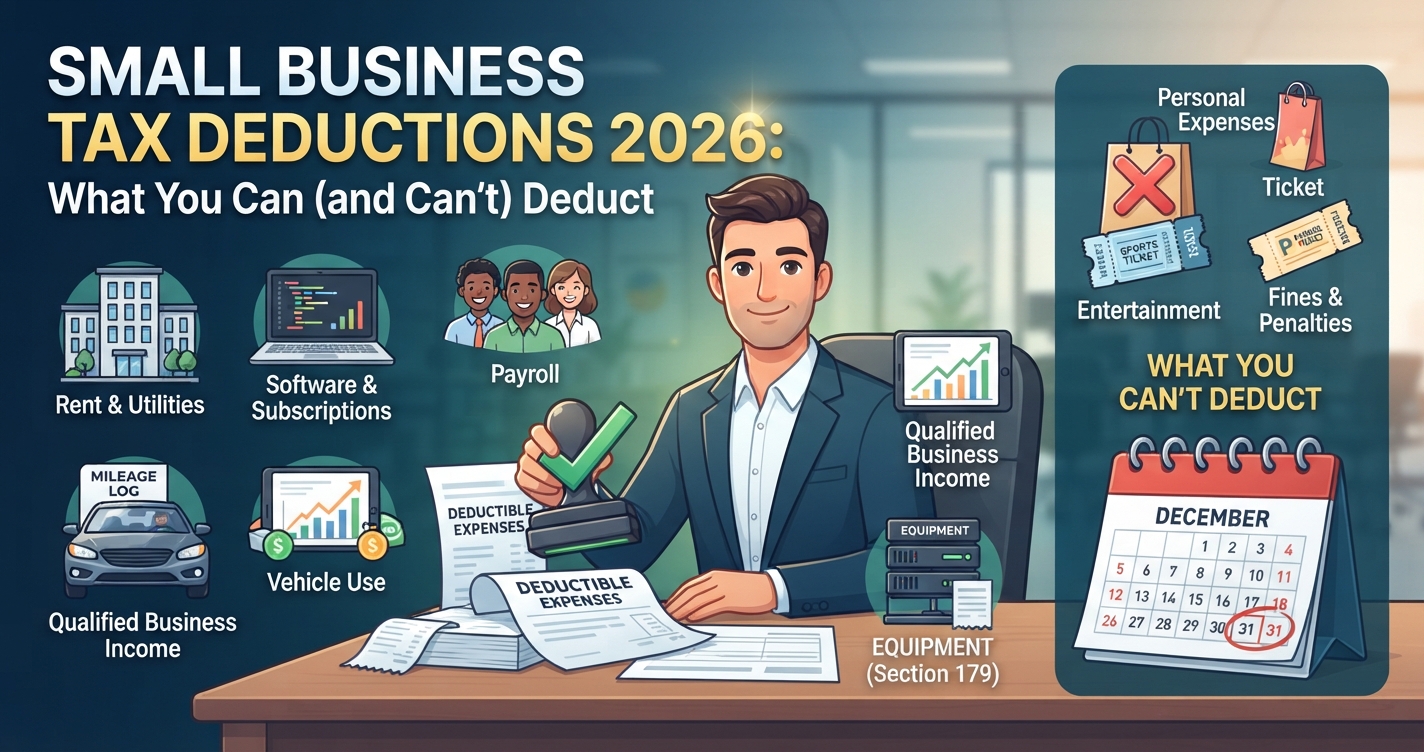
Small business tax deductions are expenses the IRS allows you to subtract from your business income to lower your taxable profit. To qualify, an expense must be both ordinary (common in your industry) and necessary (helpful and appropriate for your business). For 2026, the most valuable deductions include the 20% qualified business income deduction, 100% bonus depreciation, Section 179 equipment expensing up to $2.56 million, the business mileage rate of 72.5 cents per mile, and everyday costs like rent, software, insurance, and payroll.
With three months left in the year, this is the best time to review what you’re claiming. Expenses generally need to be incurred by December 31 to count for 2026, so a quick review now can still change your tax bill. Here is a complete breakdown of what small businesses can deduct, what they can’t, and how to keep the records that make deductions hold up.
What Makes an Expense Deductible?
The IRS applies a simple two-part test. An expense must be ordinary, meaning it’s common and accepted in your line of business, and necessary, meaning it’s helpful and appropriate for running that business. It doesn’t have to be indispensable. A bookkeeper’s software subscription, a client lunch, and a work vehicle’s fuel all meet the test for most businesses.
Two more conditions matter. The expense must be for the business rather than personal use, and you must be able to document it. A deduction you can’t back up with a receipt, invoice, or log is a deduction you may lose in an audit.
The Most Common Small Business Deductions
| Category | What Qualifies | Key Rule for 2026 |
|---|---|---|
| Rent and utilities | Office, shop, or storage space, phone, internet | Fully deductible when used for business |
| Payroll | Wages, bonuses, employer payroll taxes | Deductible when paid |
| Software and subscriptions | Accounting, design, project management tools | Fully deductible when used for business |
| Marketing | Website, ads, branding, promotional materials | Fully deductible |
| Professional services | Bookkeeping, legal, tax preparation, consulting | Business portion deductible |
| Insurance | Liability, property, professional coverage | Fully deductible |
| Business meals | Meals with clients or while traveling | 50% deductible |
| Vehicle use | Business driving | 72.5 cents per mile or actual expenses |
| Equipment | Computers, machinery, furniture | Section 179 or bonus depreciation |
| Interest and fees | Business loan interest, bank and merchant fees | Deductible when business-related |
If you want to see how these expenses should be recorded day to day, our guide on how to categorize business expenses shows the standard categories most small businesses use.
Equipment: Section 179 and Bonus Depreciation
This is where 2026 looks different from past years. Under the One Big Beautiful Bill Act, 100% bonus depreciation is permanent, and the Section 179 limit rose to $2.56 million for 2026, with the benefit phasing out once total equipment purchases pass $4.09 million.
In plain terms, you can usually deduct the full cost of qualifying equipment in the year you place it in service rather than spreading the deduction over many years. That includes computers, machinery, tools, and certain vehicles. If you’ve been thinking about a major purchase, the timing matters because the equipment generally has to be bought and in use by December 31 to count for 2026. Our OBBBA small business tax changes guide covers how these rules fit together.
Vehicle and Mileage Deductions
If you use a personal vehicle for business, you can choose between two methods:
- Standard mileage rate: 72.5 cents per business mile for 2026, up 2.5 cents from 2025, according to IRS Notice 2026-10
- Actual expenses: a percentage of gas, insurance, repairs, and depreciation based on business use
Either way, you need a mileage log showing the date, destination, purpose, and miles driven for each trip. Commuting from home to a regular workplace doesn’t count. A simple phone app or spreadsheet kept throughout the year is far easier than rebuilding a log in April.
Home Office Deduction
If you use part of your home regularly and exclusively for business, you may qualify for a home office deduction. There are two ways to calculate it:
- Simplified method: $5 per square foot of office space, up to 300 square feet, for a maximum of $1,500
- Regular method: the business percentage of rent or mortgage interest, utilities, insurance, and repairs
The “exclusive use” rule is the part that trips people up. A desk in a bedroom that doubles as a guest room generally won’t qualify, while a dedicated room used only for work generally will.
The Qualified Business Income Deduction
If your business is a sole proprietorship, partnership, S-corp, or LLC taxed as a pass-through, you may be able to deduct up to 20% of your qualified business income. The OBBBA made this deduction permanent, so it’s no longer scheduled to expire. Income limits and rules for certain service businesses can reduce or phase out the deduction, which is why it’s worth reviewing with a tax professional rather than assuming you qualify for the full amount.
Other Deductions Owners Often Miss
- Startup costs: Up to $5,000 of startup expenses can be deducted in your first year, with the remainder spread over 15 years
- Self-employed health insurance: Premiums you pay for yourself, your spouse, and dependents may be deductible
- Retirement contributions: Contributions to a SEP IRA, Solo 401(k), or SIMPLE IRA reduce taxable income
- Business travel: Airfare, lodging, and local transportation for trips away from your tax home
- Education: Courses and training that maintain or improve skills used in your current business
- Bad debts: Invoices you’ve genuinely written off as uncollectible, if you use accrual accounting
What You Can’t Deduct
Some expenses look like business costs but don’t qualify:
- Personal expenses: Groceries, personal clothing, and family travel, even if they happened during a work trip
- Estimated tax payments: These are advance payments of your tax bill, not an expense. Our guide to quarterly estimated taxes explains how to handle them
- Fines and penalties: IRS penalties, parking tickets, and similar charges
- Political contributions: Not deductible as a business expense
- Commuting costs: Travel between home and your regular place of work
- Entertainment: Most entertainment expenses, such as sporting event tickets, are no longer deductible
Recordkeeping: Where Most Deductions Get Won or Lost
A deduction is only as strong as the paper behind it. For each expense, keep a receipt or invoice, a record of what it was for, and proof of payment. Keep business and personal spending in separate accounts so nothing gets mixed together.
The IRS generally expects you to keep records for at least three years from the date you file, and longer in some situations. Businesses that stay current on monthly bookkeeping find this almost automatic, while those who wait until tax season end up reconstructing a year of transactions from memory. Our year-end bookkeeping checklist lays out exactly what to have in order before you file.
Worker classification also affects what you can deduct. Payments to true contractors are deductible, but misclassifying an employee can create penalties that outweigh the deduction. Our guide to 1099 vs W-2 classification explains the difference.
Get Help Claiming Every Deduction You Qualify For
Missing deductions means overpaying tax, and claiming the wrong ones can invite an audit. A bookkeeper who keeps your records clean and a tax professional who knows the current rules make that balance much easier. See our Tax Planning Services and Business Tax Preparation to learn how we help Sanford and Central Florida businesses, or browse our full range of services.
For the IRS’s official list and rules, see IRS Publication 535, Business Expenses.
Frequently Asked Questions
What are the most common small business tax deductions? The most common include rent, utilities, payroll, software, marketing, insurance, professional fees, business meals at 50%, vehicle expenses, and equipment purchases.
What is the 2026 business mileage rate? The IRS standard mileage rate for business use in 2026 is 72.5 cents per mile, an increase of 2.5 cents from 2025.
Can I deduct my home office? Yes, if you use part of your home regularly and exclusively for business. You can use the simplified method of $5 per square foot up to 300 square feet, or calculate actual expenses.
How much can I deduct for equipment in 2026? Section 179 allows up to $2.56 million of qualifying equipment to be deducted in the year of purchase, and 100% bonus depreciation is permanent for qualifying property.
Are business meals fully deductible? No. Business meals are generally 50% deductible, and most entertainment expenses are not deductible at all.
Can I deduct my estimated tax payments? No. Estimated tax payments are advance payments of your personal tax bill, not a business expense.
Do I need receipts for every deduction? You need adequate records for every deduction. Receipts, invoices, mileage logs, and bank statements all help support your claims if the IRS asks.
Not Sure What You Can Deduct?
A short review of your books before December 31 can uncover deductions you would otherwise miss. Book a free consultation with our Sanford, FL team, or visit our homepage to learn more.